
One change : Eat protein first (why it matters for a PCOS body)
I'm not going to give you a meal plan. I'm going to explain one mechanism so clearly that you'll never eat a croissant on its own again, not because I told you not to, but because you'll understand what it does.

I want to talk about breakfast. Specifically, I want to talk about what happens inside your body in the 45 mins after you eat it, because for a woman with insulin resistance, that window is one of the most hormonally significant parts of her entire day, and most women are moving through it completely unaware.
This is not about clean eating, or cutting carbohydrates. It's about understanding one specific mechanism so well that a single, genuinely manageable change starts to make sense, and not just as a rule to follow, but as a decision you make because you understand the consequence of the alternative.
The mechanism is called glucose sequencing. And once you understand it, the order in which you eat your food will never feel like a trivial thing again.
What happens when you eat carbohydrate first
When carbohydrate enters your digestive system, it breaks down quickly into glucose and moves into your bloodstream. Your blood glucose rises, your pancreas detects the rise and releases insulin to manage it.
In a body without insulin resistance, this is a smooth and efficient process. The insulin appears, the cells respond, glucose is absorbed, blood sugar returns to baseline. The whole thing is quiet and unremarkable.
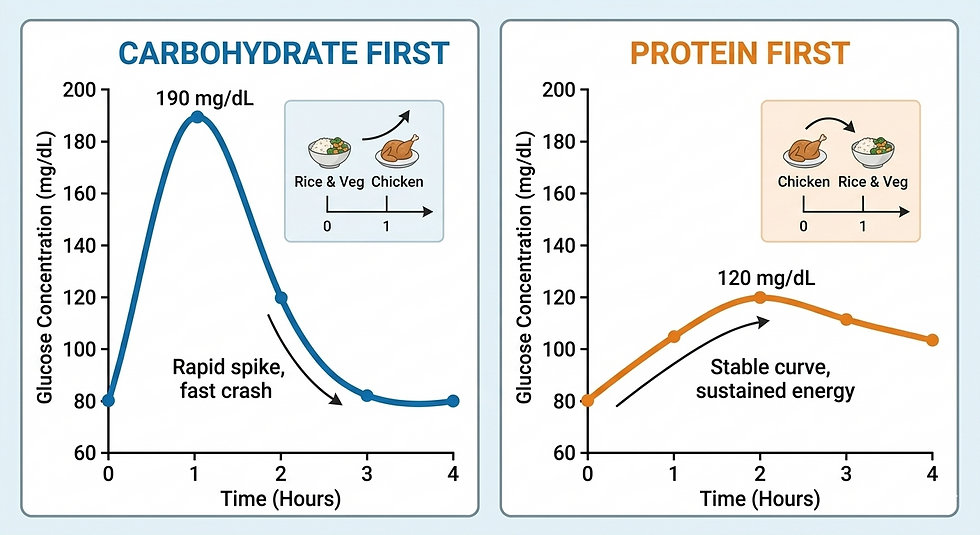
In a body with insulin resistance, which is the underlying metabolic reality for most women with PCOS, this same process produces a much larger insulin spike. The cells are less responsive, so the pancreas compensates by releasing more insulin than the situation strictly requires. Blood glucose rises sharply, insulin floods the system to manage it, and then blood glucose can drop again quickly; leaving you tired, foggy, and reaching for something sweet by mid-morning, not because you lack willpower but because your blood chemistry is asking for it.
And this elevated insulin doesn't stay quietly in the background. It travels to the ovaries and stimulates androgen production. Which means that a carbohydrate-heavy breakfast, eaten without anything to buffer it, is in a direct and measurable way a conversation with your hormone levels.

Now here is what changes when you eat protein first
Protein slows everything down. When you start a meal with a protein source — eggs, labneh, Greek yoghurt, a handful of nuts, leftover chicken, whatever is real and accessible in your life; several things happen before the carbohydrate even arrives.
Your stomach empties more slowly. Glucose from any carbohydrate you eat afterwards enters the bloodstream gradually rather than all at once. The peak of your post-meal glucose spike is lower and the curve is flatter. Your pancreas releases less insulin in response because the demand is lower, and the downstream androgen signal to your ovaries is quieter.
This is what researchers call the glucose sequencing effect, and the studies behind it are not small or preliminary. A 2023 trial published in Nature Metabolism showed that eating protein and vegetables before carbohydrate reduced post-meal glucose spikes by up to 46% compared to eating carbohydrate first, even when the total food consumed was identical. Same meal, different order, profoundly different metabolic response.
For a woman with PCOS, that difference is not cosmetic, it is hormonal.
What this looks like in a real morning
I want to be specific here because vague nutritional advice is one of the things that has failed women with PCOS most consistently.
If your current breakfast is toast, a bowl of cereal, a fruit smoothie, or as is very common in the UAE, something sweet with tea, you are starting your day with a carbohydrate-first glucose spike before you've done anything else. That spike sets the insulin tone for the hours that follow.
A protein-first morning does not have to be complicated or expensive. Two eggs in any form. Full-fat labneh with a small amount of bread eaten after. A handful of walnuts before your dates. Greek yoghurt before your fruit. The carbohydrate does not disappear, it simply arrives after something that changes how your body processes it.
The cultural food landscape in the UAE and across the region is genuinely rich in protein-forward options. This is not a change that requires you to abandon the way you eat. It requires you to reorder it, with an understanding of why the order matters.
One change, done properly
I could give you ten nutritional principles for PCOS. I have chosen not to, because ten principles compete with each other and none of them get implemented. One principle, explained at the level of mechanism, tends to stick because it makes sense, and because when something makes sense you don't need willpower to maintain it. You just need to remember what you know.
"When something makes sense, you don't need willpower to maintain it. You just need to remember what you know."
Eat protein first. Not forever perfectly. Not with anxiety when you can't. But as a consistent default, chosen consciously, because you now understand what it is doing for your insulin, your androgens, and ultimately your symptoms.
That is not a diet. That is a lever.
Hurmonaat's first cohort starts on 4th May, and founding member intake closes on then. If you join before then, you come in at almost half the programme price. That rate exists because the first women who trust something new deserve to be recognised for it.
The first step is a free 30-minute discovery call with me. We talk through your picture: your symptoms, your history, what you've tried. If the programme is right for you, I'll tell you honestly. If it isn't, I'll tell you that too.
The founding rate closes soon. If something in this post resonated, don't sit on it.
Book your call here or come and find me at @hurmonaat on Instagram.
Dr Farida Fanda
GP · Founder, Hurmonaat
FanCare Solutions, UAE


Comments